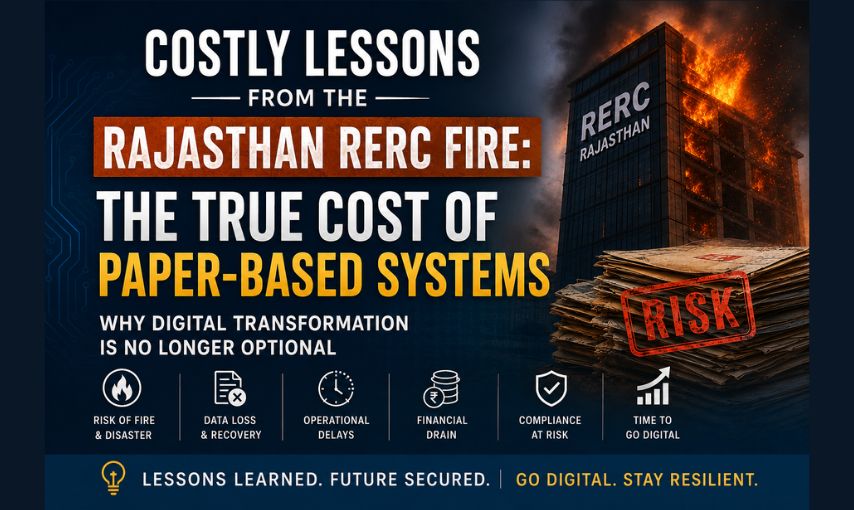
A recent fire incident at the Rajasthan Electricity Regulatory Commission (RERC) office in Jaipur has once again raised serious concerns about how organizations and government departments manage and protect critical records. According to media reports, the fire broke out on the fourth floor of the RERC building, where several important files and documents related to legal matters and electricity projects were stored. The incident caused panic among employees and led to damage of valuable records that may take years to recover or recreate.
While authorities managed to control the fire before it spread to the entire building, the incident exposed a much larger issue that many organizations still ignore, the risk of depending entirely on physical document storage systems.
In today’s digital era, where information is one of the most valuable assets for any organization, relying solely on paper-based records can lead to massive operational, legal, and financial losses. Fires, floods, accidental damage, theft, and even human error can destroy years of important documentation within minutes. The RERC office fire serves as a strong reminder that organizations need to modernize their document handling systems and move toward secure digital document management solutions.
What Happened at the RERC Office?
According to reports, the fire started on the fourth floor of the Rajasthan Electricity Regulatory Commission building in Jaipur. Thick smoke quickly filled the area, creating a dangerous situation for employees and officials working inside the office. Fire department teams were immediately dispatched to the location, and after significant efforts, the blaze was brought under control.
Initial reports suggested that the fire may have been caused by an electrical short circuit. However, the biggest concern was not only the structural damage but also the destruction of important official records stored inside the affected rooms.
The damaged documents reportedly included files connected to power projects, electricity regulations, legal disputes, tariff matters, and administrative records. Since many of these documents are highly sensitive and linked to long-term government and infrastructure projects, their loss could create complications in future proceedings and decision-making processes.
Even when organizations maintain duplicate physical files, recovering information after such incidents becomes time-consuming, expensive, and sometimes impossible.
Why Physical Documents Are Vulnerable
Many offices, government departments, and enterprises in India still maintain large archives of paper files. Cabinets, storage rooms, and physical record sections continue to be the primary method of storing critical information.
Although this traditional approach has been followed for decades, it comes with major risks.
1. Fire Damage
As seen in the RERC incident, a single electrical fault or fire accident can destroy years of records within minutes. Paper documents are highly flammable, and once a fire spreads, recovering documents becomes nearly impossible.
2. Floods and Water Damage
Natural disasters, leaking pipelines, monsoon flooding, or firefighting activities can also damage paper records permanently. Water-damaged files often become unreadable due to ink spreading, fungal growth, or paper deterioration.
3. Misplacement and Human Error
Physical files can easily get misplaced, lost, or incorrectly stored. In large organizations managing thousands of documents daily, manual handling increases the possibility of errors.
4. Unauthorized Access
Paper documents are difficult to track and monitor. Unauthorized individuals may access confidential information without leaving any digital audit trail.
5. Storage Costs
Maintaining physical records requires dedicated storage rooms, cabinets, security arrangements, and administrative staff. Over time, this increases operational costs significantly.
6. Slow Retrieval Process
Finding specific records from large physical archives can take hours or even days. This delays operations and reduces workplace productivity.
The Growing Importance of Digital Transformation
Organizations worldwide are now shifting toward digital transformation to improve efficiency, security, and business continuity. One of the most important parts of this transformation is adopting a Document Management System (DMS).
A Document Management System allows organizations to digitize, organize, store, and retrieve documents electronically through a secure centralized platform.
Instead of depending on paper files stored in office buildings, documents can be safely maintained on cloud servers or protected digital infrastructure with backup and recovery systems.
This means that even if a fire, flood, or other disaster damages a physical office, important records remain secure and accessible.
Benefits of a Document Management System
1. Secure Digital Storage
A DMS securely stores documents in digital format, reducing dependence on physical paper files. Multiple backup copies can be maintained automatically to prevent data loss.
2. Disaster Recovery Protection
One of the biggest advantages of digital document management is disaster recovery. Even if a physical office faces fire or natural disasters, digital records remain protected and can be restored quickly.
3. Fast Document Retrieval
Employees can search and retrieve documents instantly using keywords, tags, dates, or document categories. This saves time and improves operational efficiency.
4. Better Security and Access Control
Modern DMS platforms provide role-based access controls. Organizations can decide who can view, edit, download, or share documents.
5. Workflow Automation
Approvals, file sharing, document movement, and internal communication can be automated through digital workflows, reducing paperwork and delays.
6. Compliance and Audit Support
Digital systems maintain detailed logs and audit trails that help organizations comply with regulatory requirements and internal governance standards.
7. Reduced Operational Costs
Organizations can reduce printing, paper storage, courier, and administrative expenses significantly by adopting digital document systems.
Government Offices and Enterprises Must Modernize
The RERC fire is not an isolated case. Similar incidents have occurred in various government buildings, court offices, municipal departments, corporate offices, and warehouses across India and other countries.
These incidents repeatedly highlight the urgent need for modernization in document management practices.
Government departments often handle highly sensitive information related to public administration, infrastructure projects, finance, taxation, legal matters, and citizen services. Losing such records can create delays in public services, legal disputes, and administrative processes.
Similarly, private enterprises also manage contracts, employee records, customer data, invoices, compliance documents, and intellectual property that require secure handling.
In both sectors, digital document management is no longer optional, it has become a necessity.
How Document Management Software Helps Organizations
Modern document management software offers much more than simple digital storage. Advanced systems now provide intelligent indexing, OCR (Optical Character Recognition), workflow automation, integration with ERP and CRM systems, secure cloud access, and real-time collaboration tools.
Organizations can scan old physical records and convert them into searchable digital documents. Employees can securely access files remotely without depending on physical storage rooms.
This improves productivity, supports hybrid work environments, and strengthens overall business continuity planning.
A Smart Solution: Adopt DocEdge DMS
To prevent incidents like document loss during fires or disasters, organizations should consider implementing a reliable document management solution such as DocEdge DMS.
DocEdge DMS helps organizations digitize and manage their documents securely through a centralized platform. The solution offers features like:
- Digital document storage
- Intelligent indexing and search
- Workflow automation
- Secure user access controls
- Cloud backup and recovery
- Version control and audit tracking
- Easy document sharing and collaboration
By adopting solutions like DocEdge DMS, organizations can significantly reduce the risks associated with physical document storage while improving operational efficiency and compliance management.
Conclusion
The fire incident at the Rajasthan Electricity Regulatory Commission office is a powerful reminder of how vulnerable physical document systems can be. Important records built over years can disappear within minutes due to accidents, technical failures, or disasters.
As organizations continue to generate massive volumes of data and documentation, relying solely on paper-based systems is no longer practical or secure.
Digital document management is now essential for ensuring business continuity, protecting sensitive information, improving efficiency, and reducing operational risks.
Incidents like the RERC office fire should encourage both government departments and private enterprises to rethink their record management strategies and invest in modern, secure, and scalable document management systems such as DocEdge DMS.
The future of document security is digital, and organizations that adapt early will be better prepared for the challenges of tomorrow.